Shape: Bucatini — The Hollow Heart of Rome

Some pasta shapes whisper of place. Bucatini shouts it.
It is the voice of Rome itself — boisterous, unpretentious, gloriously unruly. It doesn’t twirl neatly like spaghetti; it slurps, it splashes, it stains shirts with red. But that’s the point. In Lazio, eating isn’t performance — it’s participation. And nothing invites participation quite like a tangle of bucatini.
If you lift a forkful in Trastevere or Testaccio, you’re not just lifting wheat and water. You’re raising centuries of appetite. Bucatini carries the echo of shepherds, the hum of trattorie, the genius of cooks who made perfection from simplicity. It is a shape of contradictions — thick yet hollow, peasant yet urbane, humble yet philosophical — and therein lies its beauty.
Shape and Soul
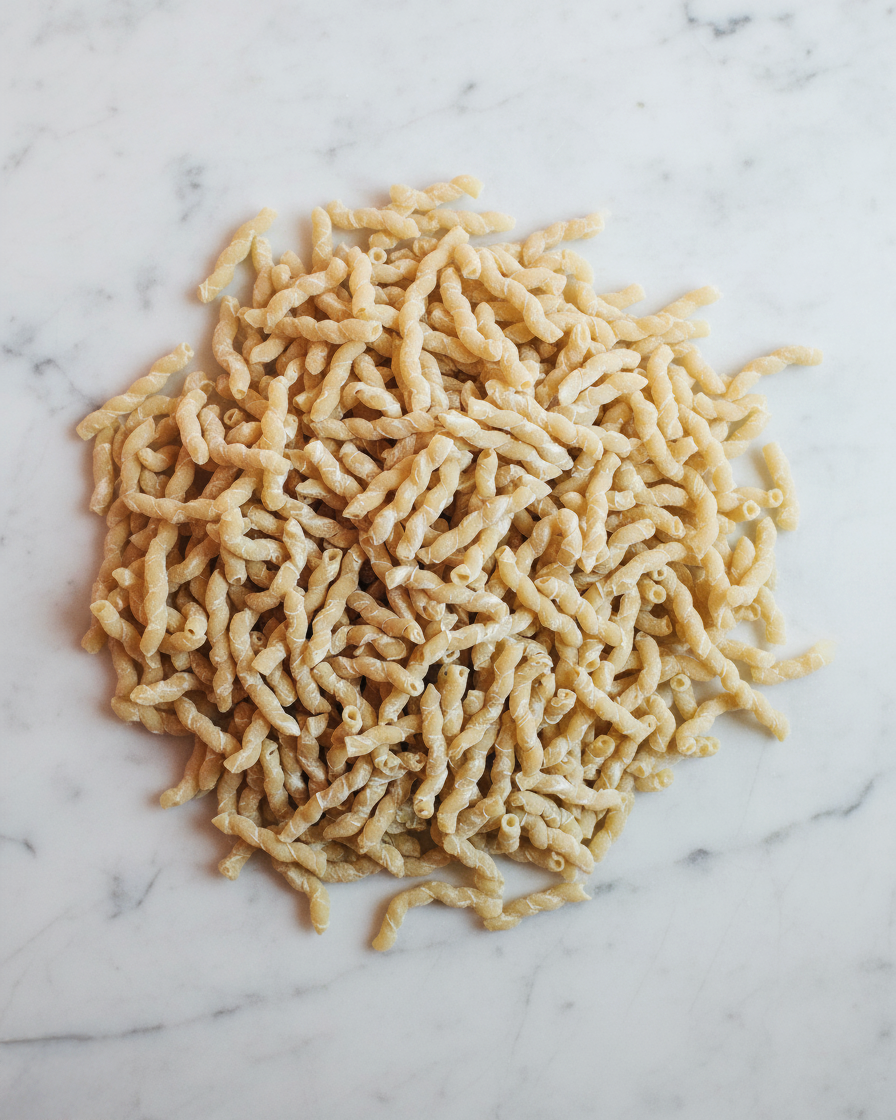
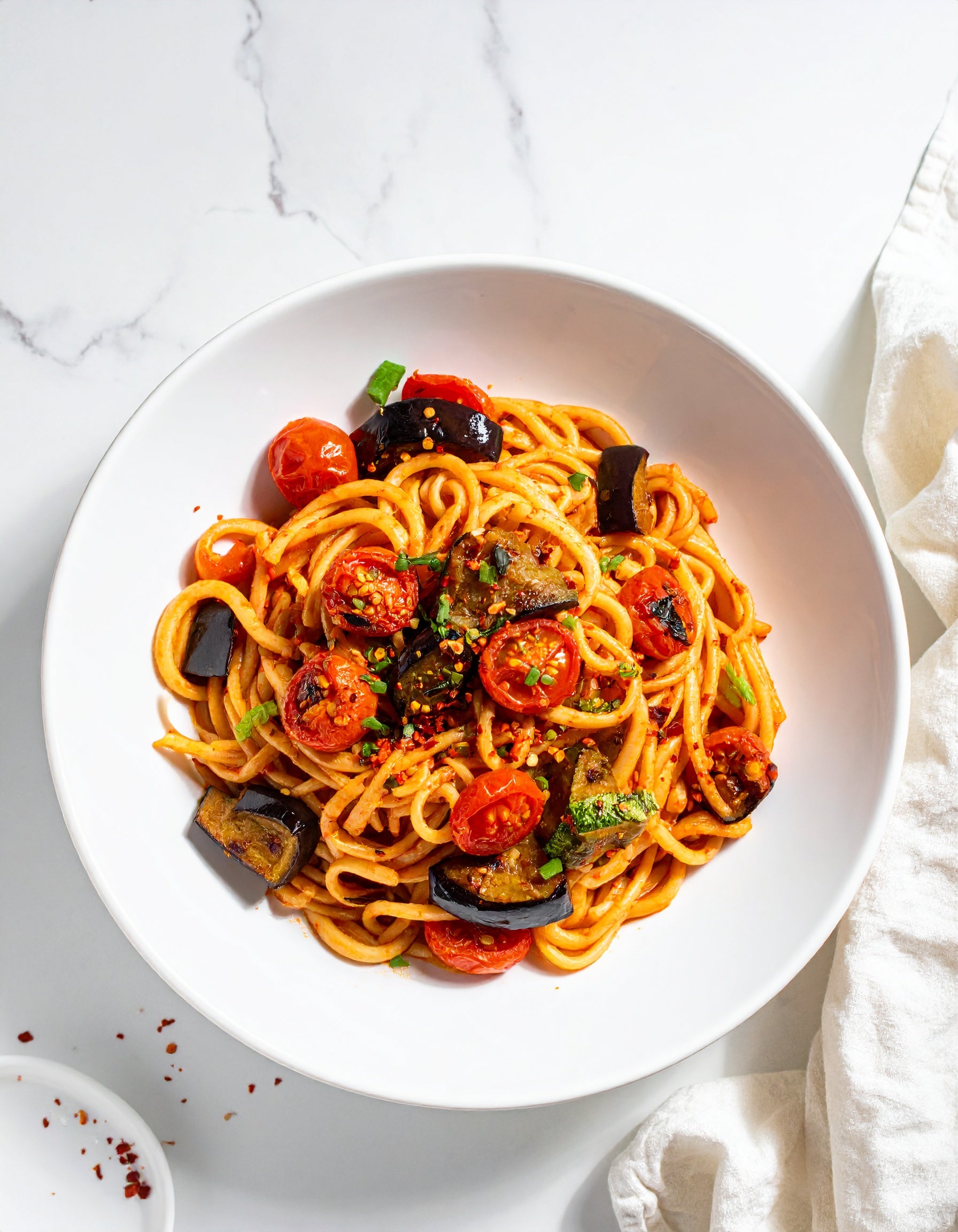
The word bucatini comes from buco — “hole” — the simplest Italian word for one of its most ingenious ideas. Each strand is like a long, round tube of pasta, slightly thicker than spaghetti, with a narrow channel running through the center. That hole isn’t decoration: it’s architecture. It allows heat, water, and sauce to travel through the strand, creating a balance of chew and softness that is unmistakably Roman.
Historically, bucatini evolved from early perciatelli — a southern shape found in Naples and Sicily. But in Lazio, it became something else entirely. Romans, always pragmatic, loved its sturdiness: thick enough to stand up to hearty sauces, but still refined enough for city appetites. By the late 19th century, it had become the official companion to the region’s boldest sauce: Amatriciana.
Yet bucatini’s story goes deeper than a single dish. It reflects the Roman mind at work — practical, sensual, a little mischievous. “The hole,” locals joke, “is there so the sauce can breathe.” More truthfully, it’s there because Romans never waste an opportunity for pleasure — not even inside a strand of pasta.
The Roman Table: A Landscape of Appetite
To understand bucatini, you must first understand its stage. Lazio’s geography reads like a recipe: volcanic soils rich with minerals, olive groves in Sabina, the salt of the Tyrrhenian coast, and fields of durum wheat stretching across the Agro Pontino plains.
In these plains, wheat meets water — and that marriage shaped the pasta culture of central Italy. By the early Renaissance, the Lazio countryside was dotted with watermills grinding durum wheat into semolina, a finer, stronger flour than the soft wheats of the north. It produced pasta that could be dried, stored, and boiled to a satisfying bite — exactly what urban Rome demanded as its population boomed.
Where the Neapolitans created long, smooth pasta for tomato and seafood, the Romans sought density. They wanted noodles that could wrestle with guanciale, pecorino, pepper — the heavy trio that defines their cuisine. Bucatini, with its tubular muscle and inner breath, became the perfect match.
 Craft: The Art of the Hole
Making bucatini by hand was once an act of both patience and precision. Before industrial dies existed, cooks used thin reeds or metal wires to pierce the dough as it was rolled. This was “pasta con il buco,” literally pasta with a hole.
Today, artisans achieve the same effect using bronze dies — a Roman tradition that never went out of fashion. The coarse surface produced by bronze extrusion helps sauce cling, while slow drying at low temperatures preserves the wheat’s nutty aroma.
Modern producers like Pastificio Secondi in Rome or Mannetti in nearby Amatrice still work this way, keeping the craft alive in small workshops that smell of toasted grain and steam.
The texture of good bucatini is unmistakable. Bend it uncooked and it hums softly. Boil it and it resists — firm, elastic, never limp. When perfectly al dente, it offers a double sensation: the bite of the outer layer, and the subtle give of the hollow center as it fills with sauce and air. It’s like chewing architecture.
Sauce Logic — Why It Works
Romans love balance through excess: fat against salt, pepper against starch. Bucatini is the conductor of that orchestra.
The classic pairing, of course, is Bucatini all’Amatriciana — guanciale rendered to golden crispness, simmered with tomato and white wine, finished with pecorino romano and black pepper. Each strand acts as a channel, drawing the sauce not only around but through it. You taste the guanciale’s smoke in every bite; you feel the tang of tomato at the core of the noodle.
The physics are perfect. The hollow core lets heat escape gradually, keeping the pasta hot without overcooking. The thick walls retain bite, while the rough surface clings to even the lightest sheen of oil. Where spaghetti can become slippery, bucatini grips. It demands to be chewed — a virtue in Roman eyes, where softness is suspect and texture is truth.
Other sauces also find harmony with bucatini:
- Gricia, the “white Amatriciana,” with guanciale and pecorino only, coats it like velvet.
- Cacio e pepe, though traditionally served with tonnarelli, takes on extra drama when made with bucatini — pepper and cheese filling the tunnel like a secret.
- Aglio, olio e peperoncino, a humble late-night dish, becomes almost sculptural as oil flows through each strand like molten gold.
And beyond these classics, the shape welcomes invention. In spring, it might meet sautéed artichokes and mint; in winter, a rich oxtail ragù. Its hollow heart accepts all emotions of the season.
 The Soundtrack of a Trattoria
Step into a Roman trattoria and you’ll hear it before you see it — the slurp. Bucatini is noisy by nature. It refuses decorum. It sprays tomato, clinks against plates, provokes laughter. Romans wouldn’t have it any other way.
At Flavio al Velavevodetto in Testaccio, waiters carry steaming bowls piled high, pecorino snowing from above. At Da Enzo al 29 in Trastevere, the sauce bubbles so vividly you can smell the pork fat from the doorway. Every portion is a small act of rebellion against restraint.
There’s an old saying: chi non si sporca, non mangia bene — “who doesn’t get messy, doesn’t eat well.” Bucatini embodies that creed. Its splash is the Roman exclamation point, a punctuation of pleasure.
The Hollow in History
Food historians trace bucatini’s ancestors to the 17th century, when long hollow noodles appeared in Neapolitan cookbooks under names like perciatelli (from perciare, “to pierce”). Rome, ever the importer and improver, adopted the idea but gave it attitude.
By the 19th century, as railroads connected central Italy, pasta factories flourished along Lazio’s grain routes — Orte, Frosinone, Viterbo — using mountain spring water and hard wheat from the Pontine plains. Bucatini became one of their trademarks, so associated with the capital that guidebooks to Rome began listing “bucatini con pomodoro e guanciale” alongside monuments and ruins.
During the post-war boom, the shape became a national icon. Cheap, filling, cheerful — it appeared on film plates in La Dolce Vita and Un Americano a Roma, where actor Alberto Sordi famously wrestled with it in comedic frustration. Bucatini was suddenly everywhere: a metaphor for Italian excess, joy, and appetite.
When the 2021 global pasta shortage temporarily affected bucatini imports to the U.S., the Internet responded like Rome herself — loud and outraged. The “Great Bucatini Shortage,” as Bon Appétit called it, proved something profound: even in modern chaos, this humble tube of wheat can provoke global emotion.
Modern Rebirths
Today’s Roman chefs treat bucatini with both reverence and curiosity.
At La Pergola, Heinz Beck deconstructs Amatriciana into an airy foam served with micro-bucatini so thin they seem to levitate. At Glass Hostaria, Cristina Bowerman reinvents it with sea urchin butter, giving the old sauce a briny kiss of the Mediterranean. Roy Cáceres at Orma experiments with buckwheat bucatini, pairing it with mushroom dashi — a dialogue between Lazio and Japan.
Even street food has joined the conversation. Trapizzino, the cult Roman sandwich shop, stuffs its pizza pockets with mini-bucatini Amatriciana — proving that what once filled the empire’s bellies now fuels a global craving.
Yet despite the innovation, the soul remains the same. Good bucatini must always be al dente, unapologetically salty, unapologetically messy. It resists being tamed. That resistance is its legacy.
Regional Variations and Cousins
Beyond Rome, Lazio’s countryside has its own interpretations. In the north, around Viterbo and Tuscia, cooks use thicker hand-rolled versions — somewhere between bucatini and pici — tossed with anchovy and hazelnut sauces. In Ciociaria, farmers’ wives stretch the dough longer and drier for storage through the cold months. Along the coast near Gaeta, fishermen boil bucatini directly in tomato broth enriched with mussels and capers, turning it into a maritime hymn.
Each variation keeps the central idea: a hollow conduit between land and sauce, between simplicity and abundance. In Lazio, pasta is never background; it’s conversation.
Science of Satisfaction
Why does bucatini satisfy so deeply? There’s physics and psychology behind it.
The thickness delays the release of starch, producing a glossy emulsion that clings longer. The hollow acts like a vent, preventing collapse under dense sauces. The result is rhythm — that Roman chew, that cadence between resistance and reward.
In flavor terms, bucatini enhances umami perception: as guanciale fat seeps into the core, every bite becomes a miniature explosion. Even acoustically, it’s engineered for pleasure. The slurp, that small intake of air as you draw it in, amplifies aroma — a built-in aeration system nature would envy.
So when Romans say bucatini is “alive,” they mean it. It breathes.
Philosophy on a Fork
Rome teaches that the measure of civilisation is how you eat lunch. A plate of bucatini isn’t just sustenance; it’s a lesson in proportion, patience, and play.
You can’t rush it — cooking takes 9 to 10 minutes, and one minute too long is heresy. You can’t twirl it neatly — it’s designed to resist obedience. You can’t eat it silently — it’s made to provoke laughter.
In that sense, bucatini mirrors the Roman spirit: resilient, indulgent, always ready for debate. Every forkful carries the city’s DNA — practical like its engineers, theatrical like its emperors, a bit chaotic like its traffic.
Where to Taste It
If you want to understand bucatini, don’t go to a fine dining room first. Go where Romans actually eat:
- Flavio al Velavevodetto (Testaccio) — for the textbook Amatriciana, smoky and balanced.
- Da Cesare al Casaletto — for the Gricia that melts into the hollow like butter into stone.
- Trattoria Pennestri — for modern variations like bucatini with rabbit ragù and thyme.
- Da Enzo al 29 — for the laughter, the noise, the untranslatable Roman warmth.
Then, if you must, ascend to La Pergola, where Heinz Beck turns it into edible architecture. You’ll realise both extremes speak the same dialect — one of pleasure measured in chew.
Fun Facts & Little Truths
- The first pasta factory to mass-produce bucatini in Lazio is believed to have opened in Amatrice around 1880, exporting to Rome’s markets.
- The buco is only about 1 mm wide, but that tiny space changes the entire texture experience.
- True Romans never break bucatini before cooking; superstition says it brings bad luck — and bad sauce.
- The average Roman eats about 26 kg of pasta a year; a fair portion of that is bucatini.
- During fascist rule, bucatini was promoted as “the worker’s pasta” because it was hearty and cheap — proving even propaganda can taste good.
- Every April, Amatrice still holds the Sagra degli Spaghetti all’Amatriciana, and despite the name, most locals secretly use bucatini.
Closing — The Eternal Tube
If spaghetti is elegance and penne is precision, bucatini is rebellion. It refuses to stay quiet. It’s the sound of sauce hitting ceramic, of laughter bouncing off stone alleys, of Rome at lunch — alive, unfiltered, and gloriously human.
To eat bucatini is to join that noise, to belong for a moment to the city that taught the world how to taste time itself. It’s not perfect; it’s Roman. Which is to say — it’s eternal.