Artisan: Pastificio Famiglia Martelli — The Yellow House That Refuses to Modernise

In Tuscany, some stories don’t need embellishment; they just need to be told correctly.
The story of Pastificio Famiglia Martelli is one of them.
At the top of a medieval hill in Lari, a village that looks carved out of time, there’s a bright yellow building that hasn’t changed much in decades. No digital signage. No industrial conveyor belts. No automated labyrinth of stainless steel. Just a family-run pasta factory — one of the last of its kind — making pasta the way pasta was made before marketing departments got involved.
For Martelli, tradition isn’t nostalgia.
It’s a working method.
And if you pay attention long enough, you notice that everything about Martelli — the shapes, the pace, the flour, the drying, even the building itself — is a quiet refusal of modern uniformity.
This is Tuscany at its most stubbornly authentic.
 A Family, Not a Factory
Most pasta brands talk about family tradition.
Martelli doesn’t need to.
Walk through Lari on a weekday morning and you’ll see Martelli family members in yellow aprons moving between rooms, checking trays, testing batches, talking with visitors. They aren’t figureheads; they are the labour force. This is not a brand built around the idea of a family.
It is a family.

Their production volume is tiny — deliberately tiny.
They make only a handful of shapes, and they make them extremely well:
- Spaghetti
- Spaghettini
- Penne
- Maccheroni di Toscana
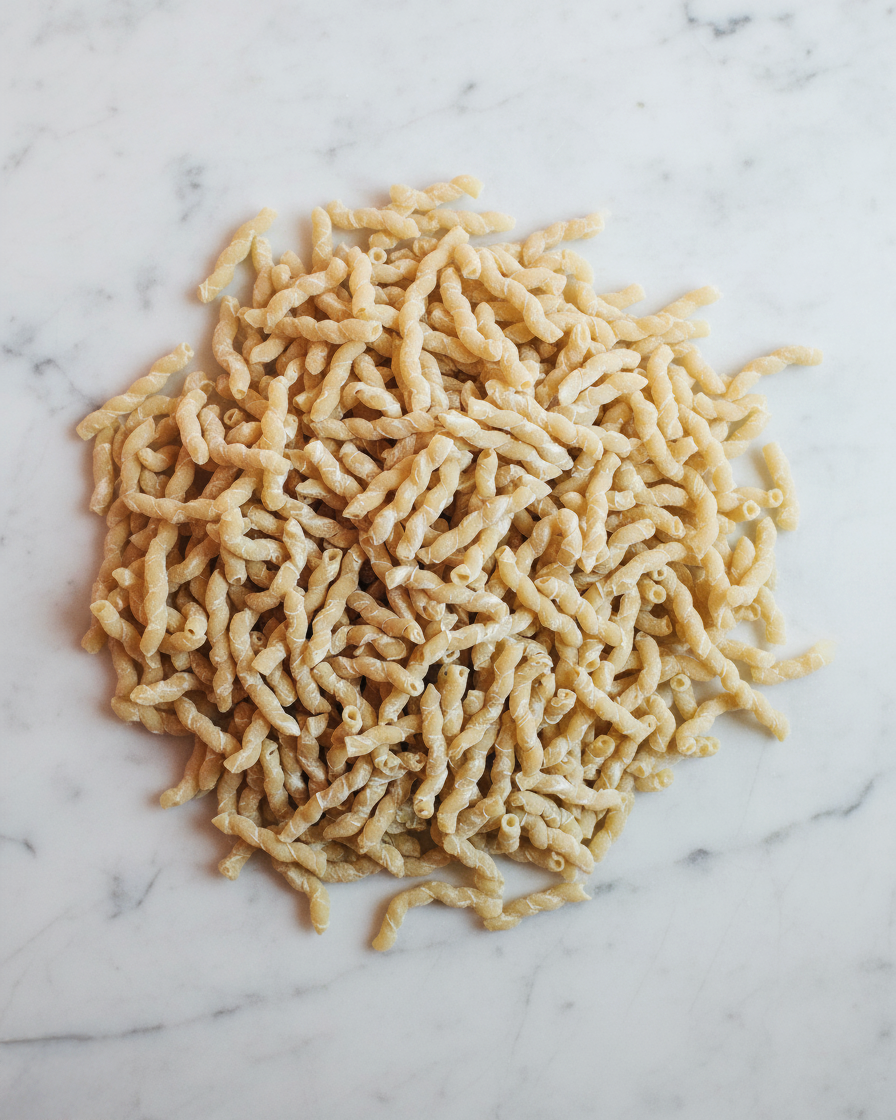
- Fusilli (more recent but still crafted with care)
No farfalline. No fancy seasonal shapes. No rainbow pasta.
Their entire identity is built on the belief that doing less is the only way to do things properly.
 The Tuscan Village That Shapes the Pasta
Lari is not an industrial town.
It’s a medieval village crowned by a fortress, surrounded by rolling hills and stone houses. There is no logical reason for a pasta factory to be here other than the fact that “here” is where the Martelli family is from.
This matters more than it seems.
In Italy, pasta factories are usually located in areas optimised for production: industrial zones, ports, plains. Martelli is the opposite — geographically inconvenient, logistically irrational, romantically perfect.
But the location is not romantic for them; it’s practical.
The specific climate in these hills — dry, stable, gently ventilated — is ideal for slow drying. You can’t rush it. Tuscany won’t let you.
And unlike modern factories that use forced hot air to finish pasta in a matter of hours, Martelli relies on:
- naturally circulating air
- low temperatures
- drying times of around 50 hours (depending on the shape)
This is not marketing language — it’s the backbone of their texture.
 Flour, Water, and Time — Nothing Else
A lot of brands love to brag about “just flour and water.”
With Martelli, the difference is everything between those two ingredients.
The Flour
They use high-quality Italian durum wheat. Not boutique ancient grains, not trendy blends — just excellent semolina chosen for flavour, gluten structure, and consistency.
Martelli understands something many industrial producers forget:
pasta should taste like wheat.
If it doesn’t, it’s dead.
The Water
Tuscan water — hard enough to structure gluten, soft enough not to mute flavour. It’s not fetishised, but it matters.
The Process
Their approach is simple, but simplicity is deceptive:
- Low-pressure extrusion
- Bronze dies (this is non-negotiable)
- Manual control of dough humidity
- Long resting times
- Slow drying at low temperatures
This is the kind of pasta that’s not trying to be perfect.
It’s trying to be true.
 Bronze Die: The Texture That Grips
Every artisan pasta claims “bronze die,” but in most cases it’s an optional feature used inconsistently across shapes.
For Martelli, every shape is bronze-extruded.
This creates a surface that is:
- slightly rough
- matt, not glossy
- micro-porous
- ready to grab sauces
This roughness is not a visual trick or a romantic signifier.
It’s the reason their pasta feels alive when tossed in a pan with tomato, oil, pepper, or pesto.
Even the simplest condimento tastes more complex because the pasta participates, instead of behaving like a slippery delivery tube.
 Drying: The Part No One Sees (But Everyone Tastes)
Slow drying is Martelli’s secret weapon.
Industrial pasta is dried at high temperatures to speed up production — sometimes as high as 100°C. This denatures proteins, kills flavour, and leads to that infamous chalky snap when overcooked.
Martelli dries at low temperatures, often taking two days to finish a single batch.
Why this matters:
- Gluten relaxes and strengthens naturally
- Wheat aroma remains intact
- Starch loses the raw taste
- Pasta cooks more evenly
- The bite is firmer, more elastic
- The sauce adheres like a second skin
This is the “Martelli bite” that chefs recognise instantly.

Why Chefs (and Nonnas) Love Martelli
Chefs don’t love Martelli because it’s artisan.
They love it because it is reliable.
Every batch cooks the same way.
Every package tastes like the last one.
Every shape behaves with dignity in the pan.
It’s the kind of pasta that allows a chef to taste the sauce before the pasta — and then trust the pasta to carry it.
Martelli pasta doesn’t fight with ingredients.
It collaborates.
That is extremely rare.
The Yellow Packaging — A Design Accident That Became Iconic
The Martelli bag is a canary-yellow rectangle with black writing.
It looks like something from 1952 because… it is something from 1952.
No illustrations.
No photos.
No shouting.
Just information.
The design has barely changed for decades, and it has now become part of their identity.
You can spot it across a room in any specialty shop.
Ironically, in a world of maximalist packaging, the Martelli bag feels avant-garde — minimalist, confident, unmistakable.
They didn’t try to be iconic.
They just never changed

Lari: The Village That Protects Their Pace
Lari is not a place where factories expand and innovate aggressively.
It’s a place where time has a different density.
The village, with its fortress and tight alleys, protects the Martelli pace.
It shields them from industrial pressure, allowing them to remain what they always were: a small, family-run pastificio producing around a few thousand kilos per day, not per hour.
In industrial logic, their scale is inefficient.
In culinary logic, it’s perfect.